
Opening
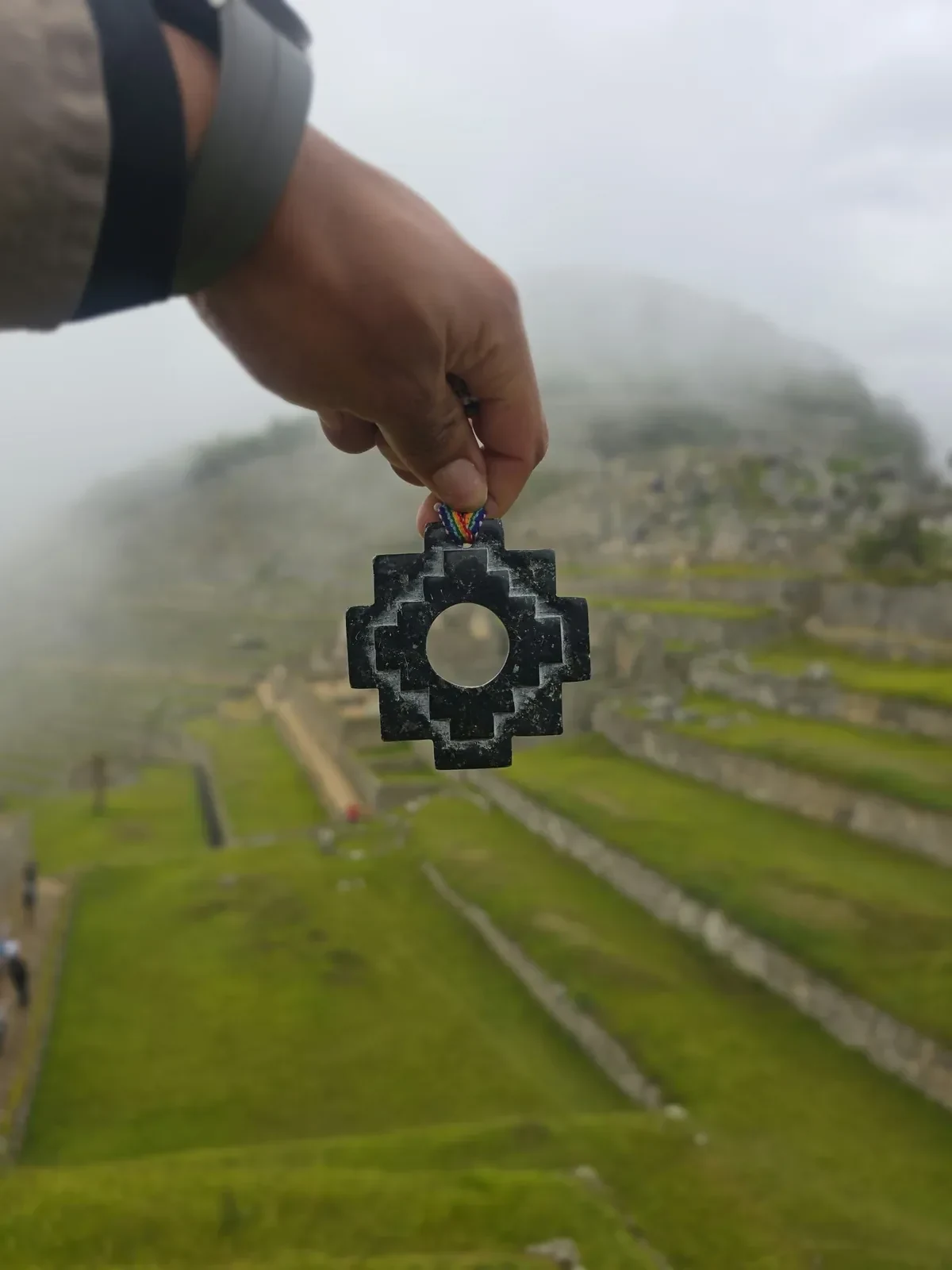
The stepped pendant in this photograph is a chakana, or Andean cross, held in front of Machu Picchu.
Older than the Inca Empire.
This is not exclusively an Inca design. LACMA’s collection traces it through roughly 4,000 years of Andean art, including a Nasca textile dated 200–600 CE.
Three realms, four directions.
One interpretation connects its four arms with directions around a centre, and its three steps with realms below the earth, on earth and in the sky. LACMA relates these levels to a serpent, a feline such as a puma, and a condor. This is an interpretation, rather than a fully deciphered code.
A ladder, a bridge and a living symbol.
The Museo Chileno de Arte Precolombino links the Quechua word chakana with a ladder or a means of crossing; the related word chaka means bridge. The name is also written chacana. Its researchers connect the design’s symmetry with ideas of balance and complementary parts. The museum also describes the chakana as a present-day expression of shared Andean Indigenous identity. It is a living cultural symbol, rather than something found only in archaeological collections.
That gives this little pendant a much bigger context against Machu Picchu’s terraces and cloud-covered mountains. Follow the journey in my Cusco and Short Inca Trail story.