
Welcome to Africa — And My Cheapest Holiday Ever
January 2024 marked something special for me: my very first trip to the African continent! And what better way to discover a completely new part of the world than by exploring Tunisia with my best friend?
But before I tell you about our adventure, here's something that might surprise you. This was actually the cheapest holiday I'd ever been on. My total spending came to around €700, including flights, accommodation and everything else along the way.
How did we manage that? Pretty simple, actually. We travelled in January, well outside the busy tourist season, booked everything ourselves and weren't afraid to use local transportation. While many visitors head to Tunisia for its beaches and all-inclusive resorts, we had a completely different plan: see as much of the country as possible in just one week.
And when I say as much as possible, I really mean it. From ancient Roman ruins and colourful medinas to coastal villages, packed minibuses and the island of Djerba, we were constantly on the move. Looking back, I'm still surprised by how much we managed to squeeze into such a short trip.
Our adventure started with an evening flight from Cologne, Germany, to Tunis, Tunisia's capital. As soon as we arrived, everything felt different. Before this trip, I'd mainly travelled around Europe, visiting different cities on short holidays. North Africa was completely new territory for me.
Different architecture, unfamiliar sounds, new languages and a way of life I hadn't experienced before. Whenever I thought about Tunisia, I pictured endless sand dunes, camels and the Sahara Desert. But I quickly discovered that the country has much more to offer, from Mediterranean beaches and fertile farmland to mountains, historic cities and the desert further south.
Before leaving, I'd also checked the Dutch government's travel advice, which made the trip feel a little more adventurous than my previous holidays. But during our journey, the kindness and hospitality of the people genuinely surprised me. We met so many welcoming locals, and some of those encounters would become our best memories.
But first, it was time to explore Tunis!
Getting Lost in the Medina of Tunis
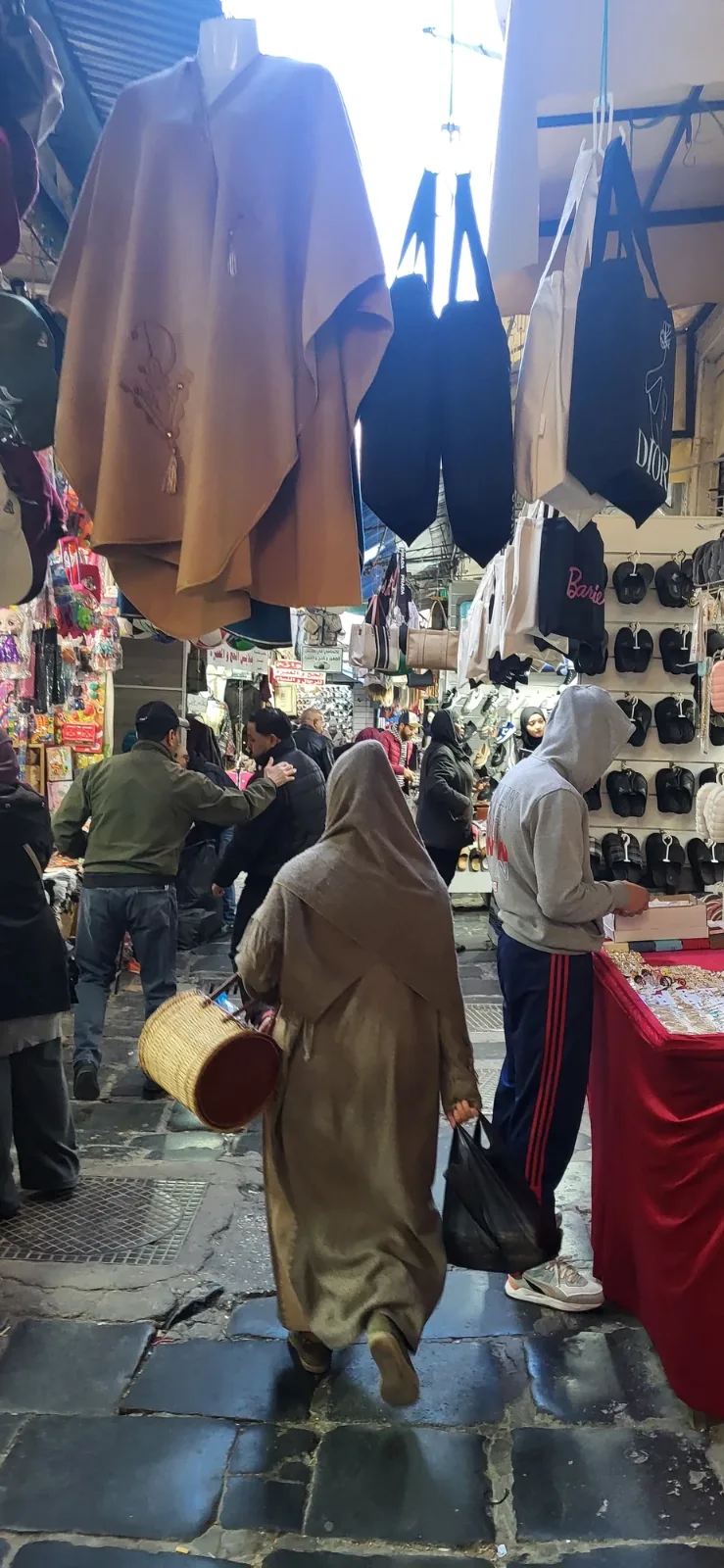
We spent our first two days discovering the capital, visiting museums, checking out street art, experiencing some nightlife and simply wandering around the city. But one of the absolute highlights was the historic Medina of Tunis.
If you've never visited North Africa before, you might wonder what a medina actually is. A medina is the historic old town of a city, often filled with narrow streets, traditional houses, mosques, courtyards and markets known as souks. And believe me, wandering through one can feel like exploring an enormous maze.
We started in the El Hafsia neighbourhood, discovering little shops, beautiful doorways and traditional buildings around almost every corner. We also visited the famous Zitouna Mosque, one of the most important historic mosques in the city. What really caught my attention was the architecture. Decorative tiles, colourful mosaics, beautifully carved doorways and details that you simply don't see everywhere in Europe.
Another interesting stop was Madrasa Es-Slimaniya, a historic Islamic educational building. A madrasa is traditionally a place of learning, often associated with Islamic religious education. Buildings like this show how important education, religion and architecture were in the development of the old city.
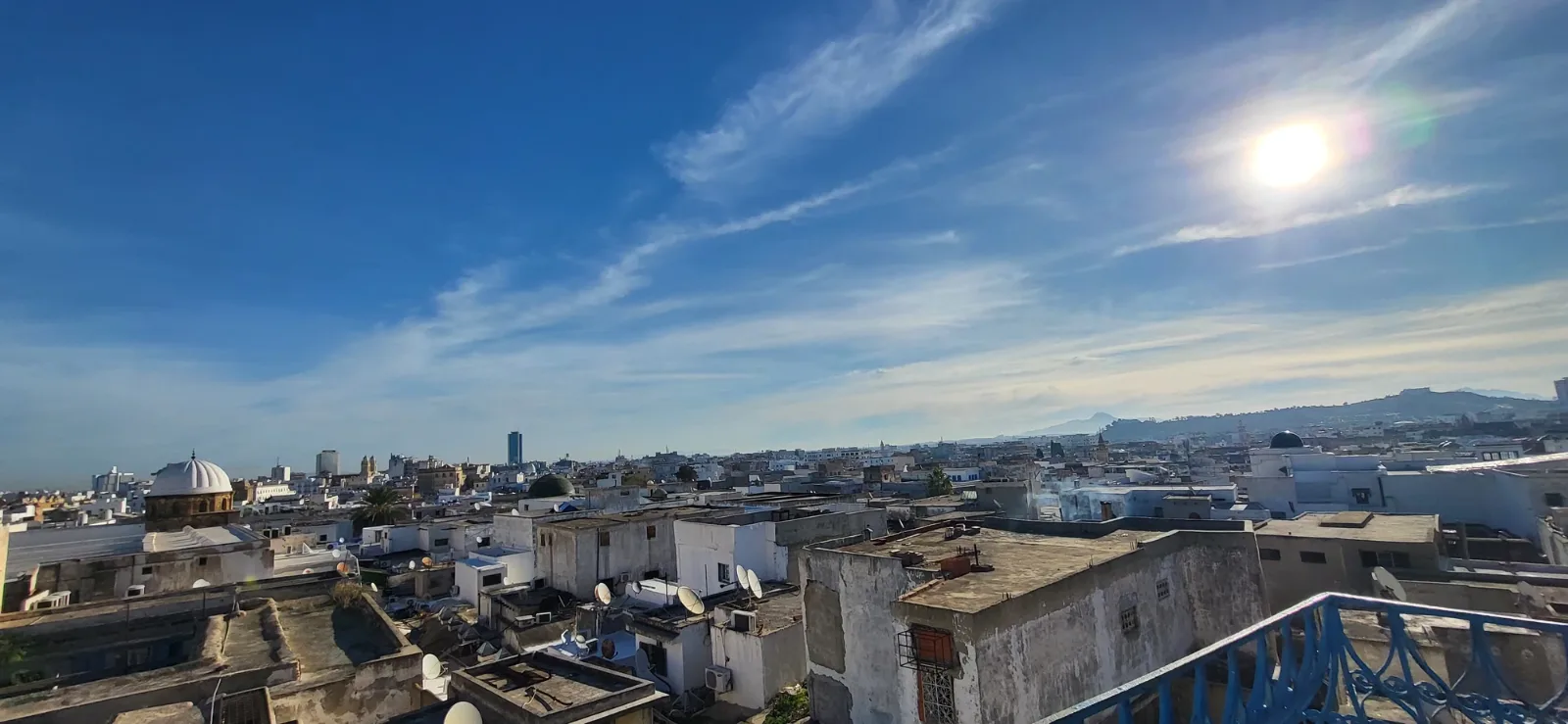
After spending quite some time getting lost in the medina, we eventually made our way to Café Panorama. And what a beautiful view! From there, you can look across the rooftops of the old town, with its historic buildings and mosque minarets stretching into the distance.
It was one of those moments where you just sit down, enjoy the view and realise how different everything feels from home.
Later, we continued towards the Tunis City Hall, also known as the Hôtel de Ville, before stopping for a glass of traditional Tunisian tea. And wow. I'd never experienced tea quite like that before. I'm pretty sure there was enough sugar in that tiny glass to give me diabetes from type A all the way to Z. 😂 Seriously, these people really know how to make their tea sweet!
Jokes aside, sharing tea is an important part of Tunisian hospitality. And honestly, I was starting to love discovering all these little cultural differences.
Carthage and the Blue-and-White Paradise of Sidi Bou Saïd
After exploring Tunis, we decided to head towards the coast. Our first destination was Carthage, one of the most historically significant places in Tunisia. Now, if you're interested in history, this is definitely somewhere worth visiting. Carthage was once one of the most powerful cities in the Mediterranean, originally established by Phoenician settlers before becoming the centre of a major trading civilisation.
You might have heard of Hannibal, the famous Carthaginian military commander who crossed the Alps with his army during the war against Rome. After a series of conflicts known as the Punic Wars, the Romans destroyed Carthage in 146 BC. The city was later rebuilt under Roman rule.
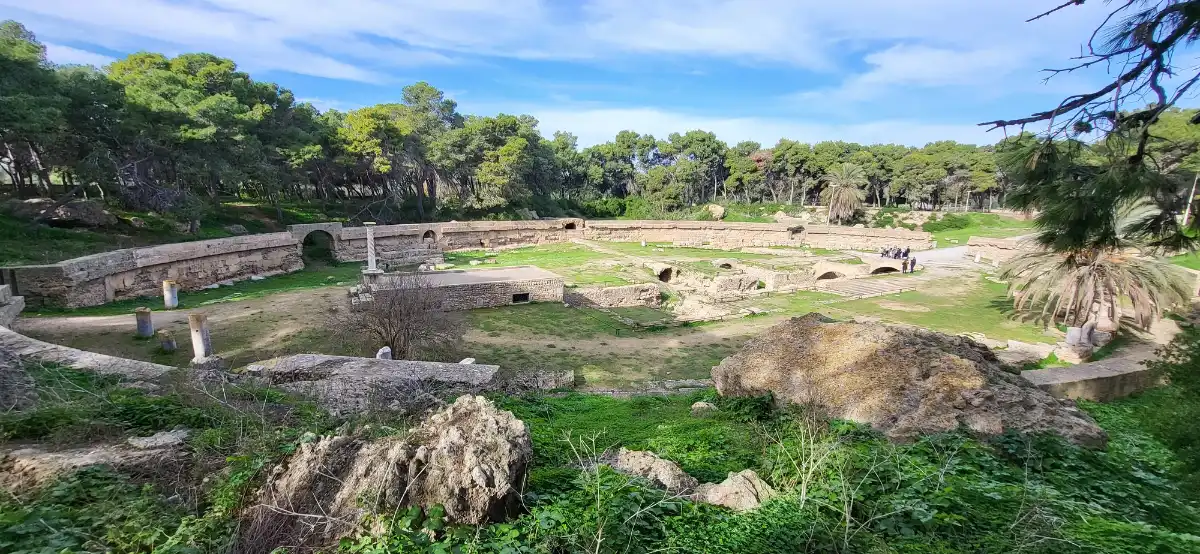
Today, you can explore archaeological remains from different periods of its history. We visited the Roman Amphitheatre of Carthage, trying to imagine what life must have been like almost two thousand years ago. Standing somewhere with that much history is pretty incredible. Afterwards, we continued towards one of the most beautiful villages we visited during our entire trip: Sidi Bou Saïd.
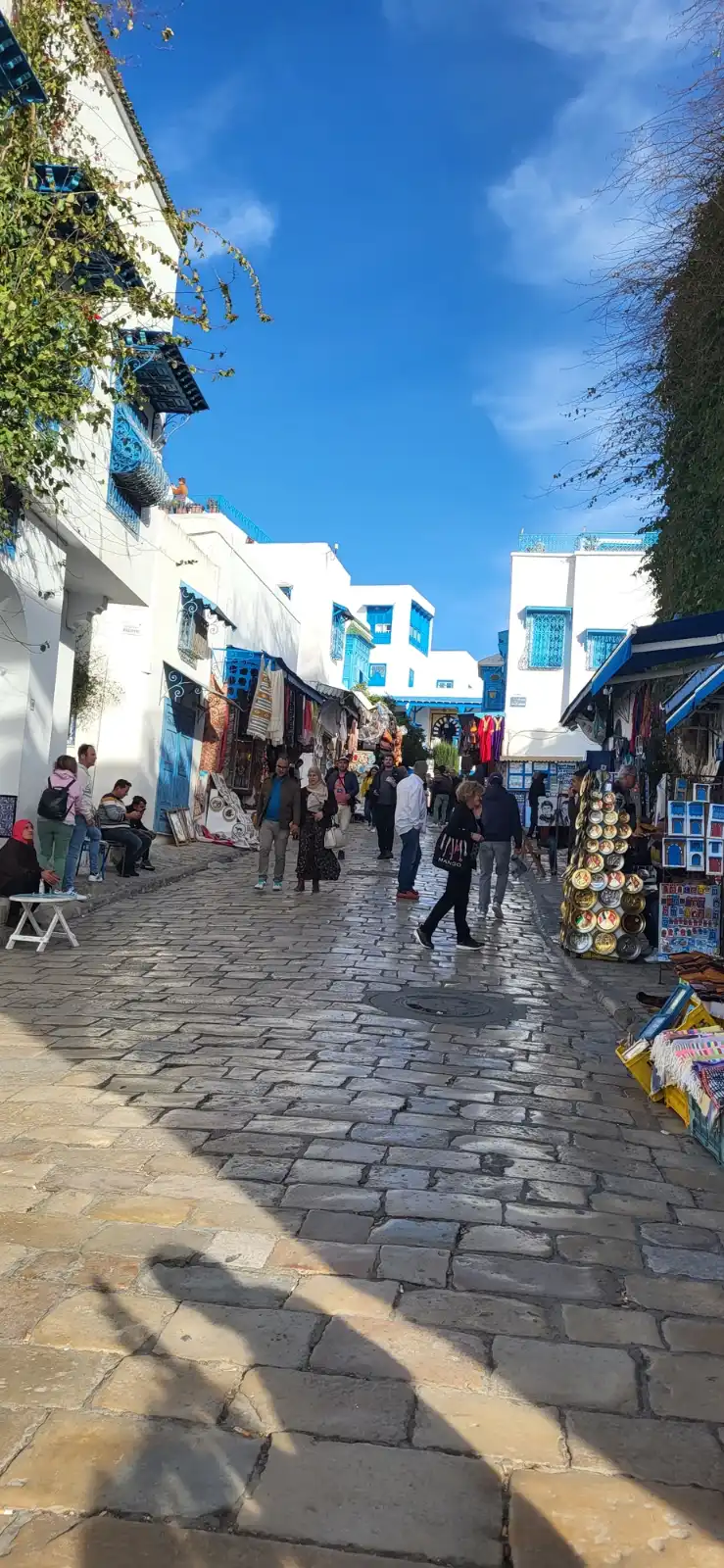
And honestly, what a place! Imagine narrow cobblestone streets, whitewashed buildings, bright blue doors, traditional balconies and beautiful views over the Mediterranean Sea. Almost everything seemed to be painted white and blue, making the entire village look like something straight out of a postcard.
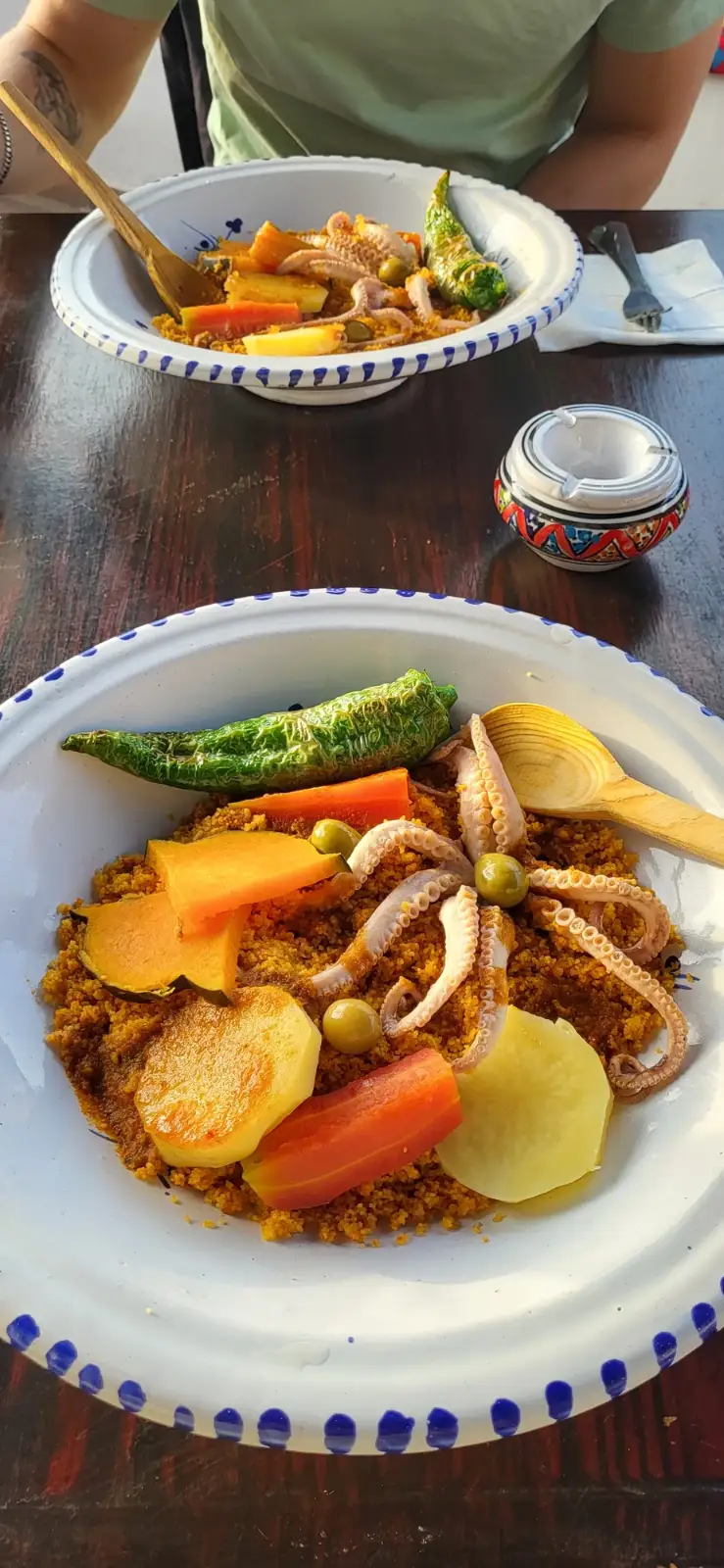
Sidi Bou Saïd sits on a hill overlooking the Gulf of Tunis and has attracted artists, writers and musicians for generations. It's easy to understand why. We spent our time exploring the streets, taking pictures and enjoying the peaceful coastal atmosphere. Eventually, all that walking made us hungry. So naturally, it was time to try some traditional Tunisian couscous.
Couscous is made from steamed semolina grains and is commonly served with vegetables, meat or fish and a flavourful sauce. It's one of the most recognisable dishes in North African cuisine, and after such a busy day, it tasted even better. As evening approached, we made our way down towards the coast and walked near the marina. Beautiful views, great food and a completely different culture. Not a bad start to our first African adventure!
An Old Train, Endless Olive Trees and Sousse
The following day, it was time to leave Tunis behind. Our next destination was Sousse, a coastal city further south, and we decided to get there by train. Now, I've travelled on plenty of trains in the Netherlands and Germany, but this one was something else. 😂
It genuinely felt like we'd travelled back in time. The train looked incredibly old, and at least where we were sitting, some of the doors seemed to be missing or weren't properly closed. Not exactly the kind of train I was used to, but hey, that's part of the adventure!
The journey itself was actually really enjoyable. We passed small villages, open fields and landscapes covered in trees. And there was one thing I kept noticing: olive trees. Everywhere. Seriously, I had absolutely no idea Tunisia had so many olive groves. It turns out that the country is one of the world's major olive oil producers, with olive cultivation playing an important role in its agriculture and economy.
We also spotted citrus trees, including orange and mandarin trees, in different places. It was another reminder that Tunisia isn't simply one enormous desert, as I'd imagined before visiting. After arriving in Sousse, we checked into our hotel and immediately went back outside. No time to waste!
Our first stop was the Medina of Sousse, another historic old town recognised by UNESCO. Although we'd already explored the medina in Tunis, this one had a different atmosphere, with impressive defensive walls and historic buildings reflecting the city's past as an important Mediterranean port.
We visited the Great Mosque of Sousse, wandered through the traditional streets and admired the old architecture. The medina has been a UNESCO World Heritage Site since 1988 and is one of the best-preserved examples of an early Islamic coastal town in the region.
Of course, we also stopped at a small local restaurant for some food. By this point, I was quickly learning that you really don't need expensive restaurants or luxury experiences to enjoy travelling. Sometimes, a good meal and a walk through a historic neighbourhood are more than enough.
Monastir — Fortresses, History and a New Sound
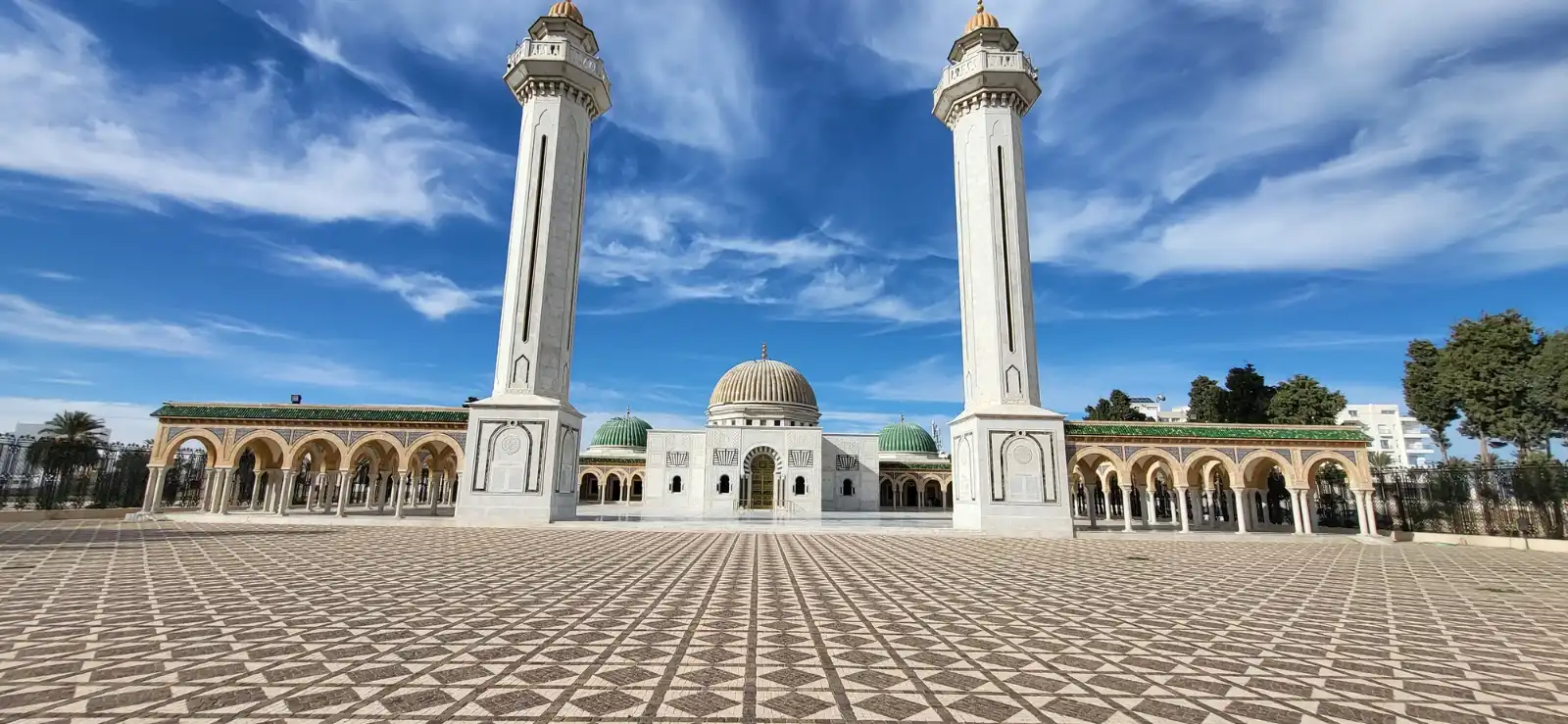
From Sousse, we took a taxi to the nearby coastal city of Monastir. And this was definitely worth the visit. Our first destination was the impressive Mausoleum of Habib Bourguiba. Habib Bourguiba played a major role in Tunisia's independence from France in 1956 and became the country's first president when Tunisia became a republic in 1957.
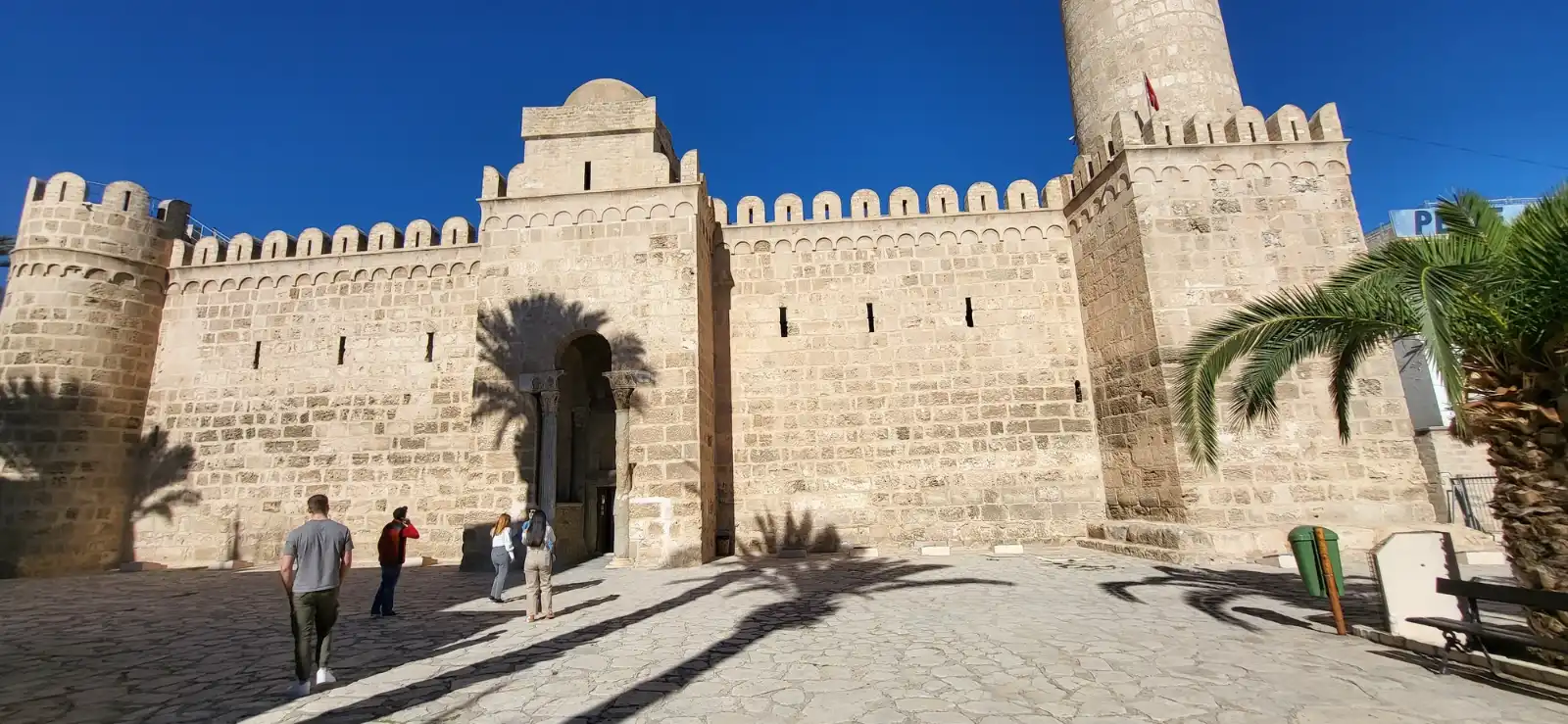
The mausoleum built in his honour is absolutely beautiful. Golden domes, elegant minarets and a grand open courtyard make it one of the most impressive buildings we saw during the trip. Afterwards, we continued towards the historic Ribat of Monastir, an enormous fortified building overlooking the Mediterranean Sea. A ribat is a type of Islamic fortress that historically combined defensive and religious functions.
The Ribat of Monastir dates back to the eighth century and is one of the country's most remarkable historic fortifications. We explored the building and enjoyed beautiful panoramic views over the city and coastline. And here's something I definitely didn't expect: the ribat was used as a filming location for the movie Monty Python's Life of Brian, released in 1979. Pretty cool, right?
But besides visiting historical buildings, there was another part of everyday life I was still getting used to.
The call to prayer.
Growing up in a small Dutch town, I wasn't used to hearing mosques throughout the day. In Tunisia, you regularly hear the adhan, the Islamic call that announces the five daily prayers.
At first, hearing the sound coming from several mosques around the city felt completely unfamiliar. Not irritating at all, just something very different from what I was used to. After a while, it actually became part of the atmosphere I associated with travelling through Tunisia.
We also noticed plenty of date palms and shops selling fresh dates. Tunisia is especially known for Deglet Nour dates, a variety appreciated for its soft texture and sweet flavour. And honestly, they're delicious!
Packed Minibuses and the Colosseum of El Jem
After Monastir, it was time to continue our journey. And this time, we ended up in what might have been one of the sketchiest-looking minibuses I'd ever travelled in. The vehicle was absolutely packed with local passengers. Barely any personal space, definitely no luxury and absolutely nothing like the public transportation I was used to back home.
But honestly? This was exactly the kind of experience we'd come for. In Tunisia, these shared taxis and minibuses are commonly known as louages. They're an affordable way to travel between different cities and towns, especially if you're happy to sacrifice a little comfort.
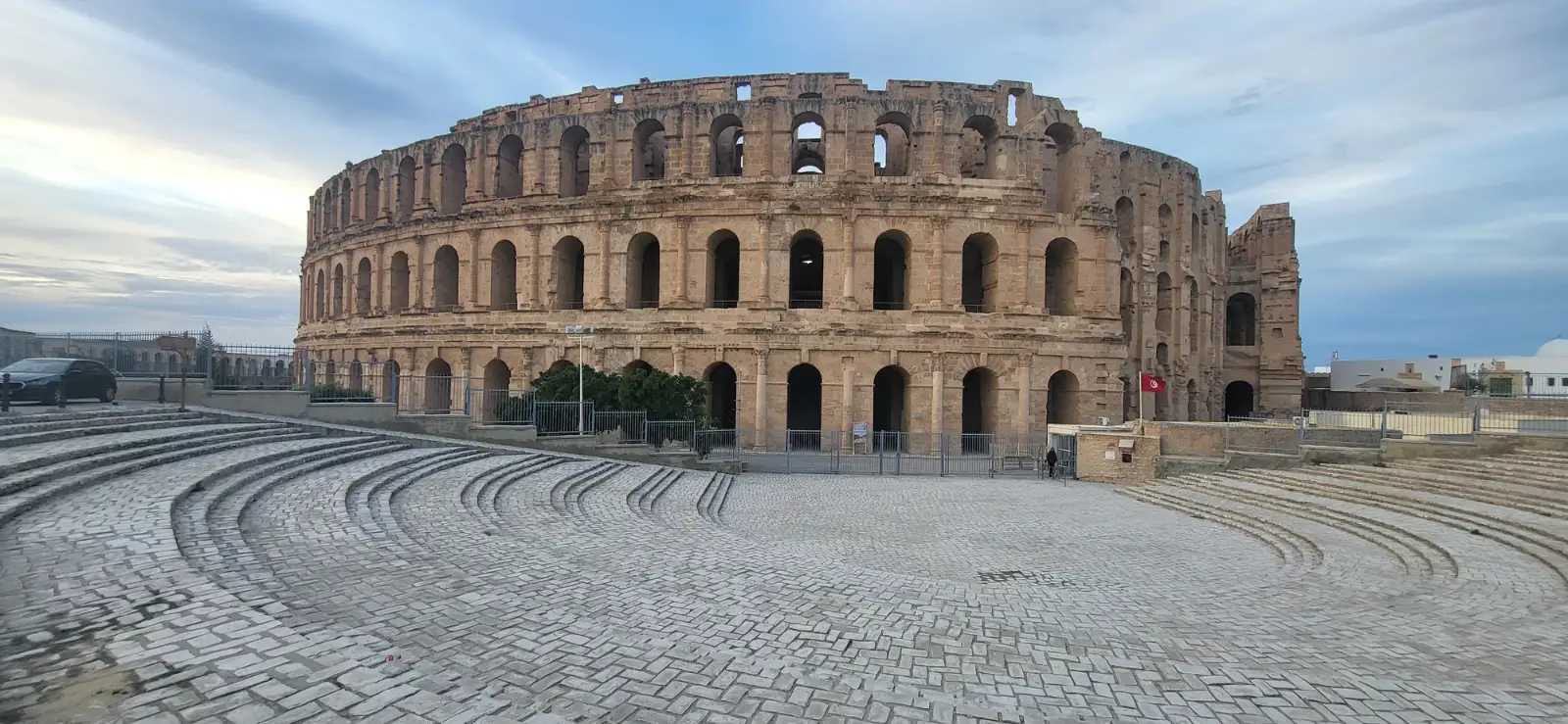
Our next stop was El Jem, and this was easily one of the biggest surprises of the entire trip. Right in the middle of town stands the enormous Amphitheatre of El Jem. And wow, it genuinely looks like the famous Colosseum in Rome!
The amphitheatre was built during the Roman period, around the third century AD, and is one of the largest surviving Roman amphitheatres in the world. Walking through the ancient structure, we could still see its enormous stone arches, passageways and the arena where thousands of spectators once gathered.
It's difficult to imagine how people managed to construct something so enormous almost 1,800 years ago without modern machinery.
But visiting smaller towns also showed us aspects of everyday life that felt completely different from what I was familiar with.
One thing that particularly stayed with me was seeing animals being slaughtered along the road and meat being handled in ways I hadn't encountered before. Growing up in the Netherlands, where most of us buy our meat neatly packaged in a supermarket, it was quite confronting.
It also made me think. If you eat meat, I believe it's important to understand where your food comes from and what happens before it reaches your plate. Of course, animal welfare and food hygiene are important everywhere, and practices differ between individual sellers. Still, it was one of those travel experiences that made me look at everyday life from a different perspective.
Along the roads, we also regularly spotted dromedaries, sometimes being offered for short tourist rides. And yes, I would eventually end up riding one myself. But more about that later!
Missing Trains, Sfax and My Perfume Obsession
After exploring El Jem, our original plan was to catch a train to Sfax, another major city along Tunisia's coast. According to the timetable, everything should have worked out perfectly. Unfortunately, reality had other plans. The train we expected wasn't available when we needed it, which meant we suddenly had to figure out another way to continue our journey. After quite a bit of effort, we eventually managed to arrange a taxi.
Another unexpected adventure added to the list! We only spent a short time in Sfax, mostly wandering around shopping areas and exploring the everyday commercial side of the city. But there was one thing that particularly caught my attention.
Perfume oils.
If there's one thing you should know about me, it's that I absolutely love perfume. And during our travels, I discovered shops selling all kinds of concentrated fragrances and aromatic oils. One scent that really stood out was oud. Oud, also called agarwood, is a highly valued aromatic material produced in the resin-rich wood of certain trees, especially species belonging to the Aquilaria genus.
It's particularly popular in Middle Eastern perfumery and is known for its deep, woody and sometimes smoky scent. Although oud doesn't originate specifically from Tunisia, these types of fragrances can also be found in perfume shops around the country. And as a proper perfume enthusiast, there was absolutely no chance I was leaving empty-handed. I ended up buying several fragrance oils to take home.
Some people collect magnets or postcards from their holidays. Apparently, I collect smells. 😂
Djerba — From Local Transport to an Almost Empty Luxury Resort
After another train journey, we finally arrived in Gabès. From there, we had to arrange yet another shared minibus to continue towards the island of Djerba. By this point, we'd become pretty familiar with the Tunisian transportation system. Find the right vehicle, wait until it's full and hope everything goes according to plan.
Eventually, we made it to the island. And after days of constantly travelling, changing cities and using whatever local transportation we could find, we decided it was time for something completely different.
Luxury!
We checked into the Radisson Blu Palace Resort & Thalasso, in the Mezraïa area of Djerba. And remember what I said about travelling outside the tourist season? Well, this was probably our best example of how much money you can save. We managed to book an all-inclusive stay for a surprisingly low price. The resort was so quiet that it almost felt like we had the entire place to ourselves.
Finally, some relaxation! Although knowing us, that wasn't going to last very long. The following day, we were already out exploring again. We visited a crocodile park and a museum, learning a little more about the island's attractions and cultural heritage. Djerba is much more than just a destination for beach holidays, something we'd discover throughout our stay.
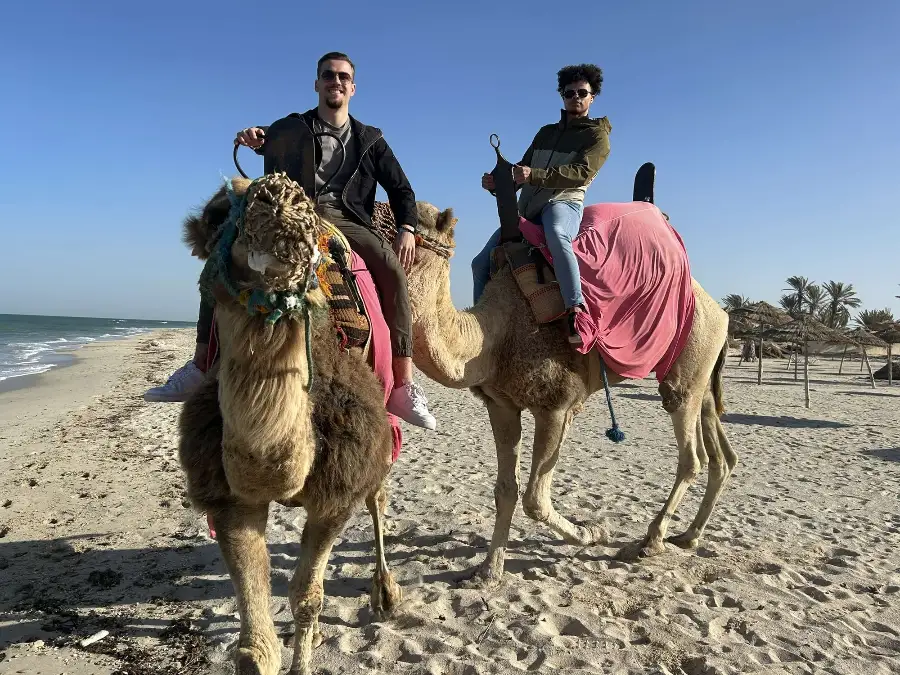
But one activity I was especially curious about was riding a dromedary. And let me tell you something. For all the men reading this, that is not the most comfortable experience in the world. 😂 I genuinely don't think my body was designed to sit on a dromedary. Still, it was a funny experience and definitely another memory to add to the collection.
And here's a small detail that many people get wrong. A dromedary has one hump, while a Bactrian camel has two. Both belong to the camel family, but dromedaries are the species commonly found in North Africa. So when you see camel rides advertised in Tunisia, you're generally looking at dromedaries.
Now you know!
Djerba's Hidden Cultural Side — Synagogues and Street Art
Djerba isn't only about sunshine, luxury resorts and beaches. The island also has a fascinating cultural history, with communities from different religious and cultural backgrounds having lived there for centuries. And something I hadn't realised before visiting was just how special its traditional architecture and settlement patterns really are.
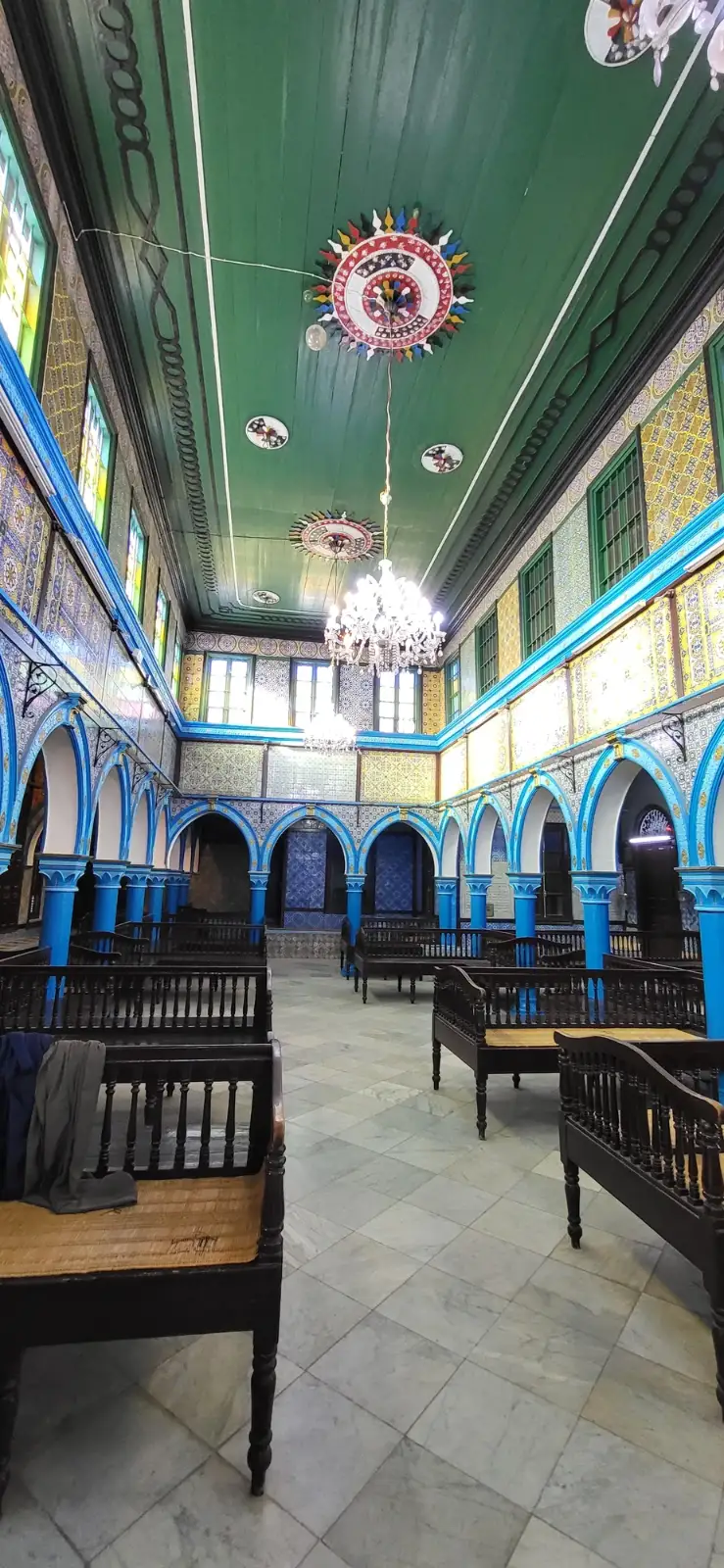
One of our most interesting stops was the El Ghriba Synagogue, located near the village of Erriadh. It's one of the most important Jewish religious sites in North Africa and reflects the long history of Jewish communities on Djerba. Visiting the synagogue was a fascinating experience and showed us another side of Tunisia's religious and cultural heritage.
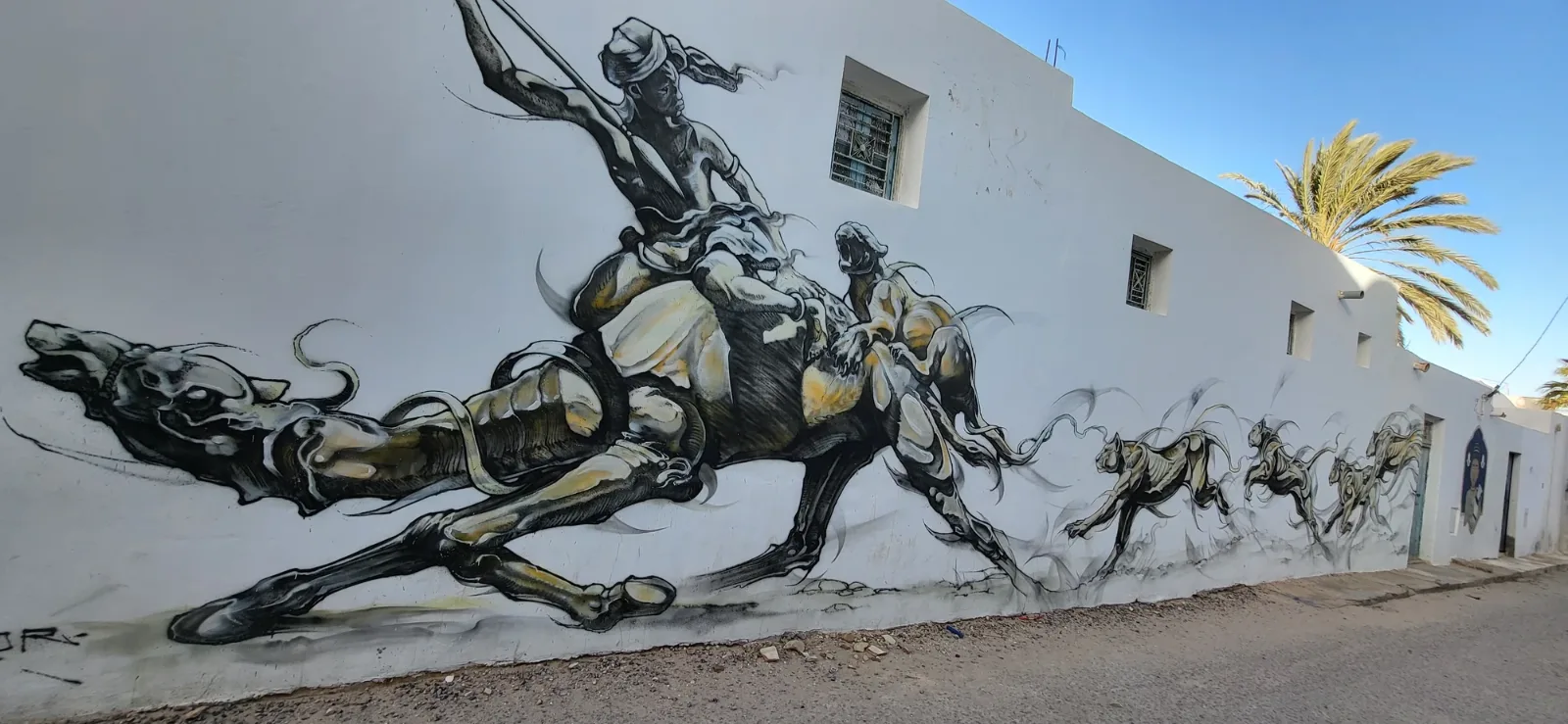
But just nearby, we discovered something completely different. Djerbahood. And as someone who enjoys street art, I absolutely loved this place. Imagine walking through a traditional village where ordinary walls, houses and narrow alleyways have been transformed into colourful works of art. That's exactly what you'll find in Erriadh, the village where the Djerbahood street-art project began in 2014.
Artists from different parts of the world were invited to create murals and artworks throughout the neighbourhood, turning it into an open-air gallery.
The best part is that you can simply walk around and discover the art yourself. No need to rush between attractions or follow a strict itinerary. Beautiful murals, unusual paintings and creative artwork appear around almost every corner, often blending with the village's traditional architecture.
It was another reminder that Tunisia has so much more to offer than the beaches and resorts it's usually associated with.
The Most Unexpected Invitation of Our Trip
Now comes one of my favourite stories from the entire adventure. During our stay on Djerba, we met a local driver. Initially, we only needed him for one journey, but after talking for a while, he offered to drive us around the island for an entire day.
If I remember correctly, we paid around €50 for the full day. For two travellers wanting to explore as much as possible, that sounded like a pretty good deal. So we agreed. And honestly, this turned into one of the most memorable experiences of the trip. Despite the language barrier, we somehow managed to communicate, laugh and build a really nice connection with him.
Then, towards the end of the day, something happened that neither of us expected.
He invited us to his home for tea with his family.
Of course, we accepted. After all, what better way to experience a country than by meeting the people who actually live there? But when we arrived, we quickly realised this wasn't going to be a simple cup of tea. There were probably around 15 to 20 family members gathered at the house.
And suddenly, there we were. Two Dutch guys sitting in the middle of a Tunisian family gathering. Everyone was incredibly welcoming. We were immediately offered tea, and before we knew it, food started appearing. Now, I have to admit something. I had absolutely no idea what we were being served.
It looked like pieces of bread that had been soaked in some kind of liquid with herbs and spices. It might have been a traditional bread-based dish, but I honestly couldn't tell you what it was called. And then came the first bite. Oh boy.
I almost started gagging. 😂 But obviously, I tried to remain completely polite. I smiled, chewed, swallowed and pretended everything was absolutely delicious. The problem? They just kept offering us more food. And more. We didn't want to appear rude or ungrateful, especially after being welcomed so warmly into their home. So we kept trying to eat, even though I was definitely struggling.
Looking back, we probably could have politely explained that we'd had enough. But with the language barrier and everyone being so generous, we weren't exactly sure how to handle the situation.
Still, despite my questionable culinary experience, it was genuinely one of the most special moments of our entire trip. We got to spend time with a local family, experience a part of everyday life that most tourists never see and connect with people despite barely speaking the same language.
And before we left, they even gave us two bottles of freshly pressed homemade olive oil. How thoughtful is that? It's moments like these that make travelling so unique. Not because everything goes perfectly, but because you experience things you could never have planned in advance.
Unfortunately, our bodies seemed to have a slightly different opinion about the experience.
The Return Journey From Hell
The following morning, both my friend and I woke up feeling absolutely terrible. Stomach problems, nausea and generally feeling like we'd been hit by a truck. We suspected food poisoning, although we never found out exactly what caused it. And of course, just to make things even more interesting, we had a flight back to Tunis that day.
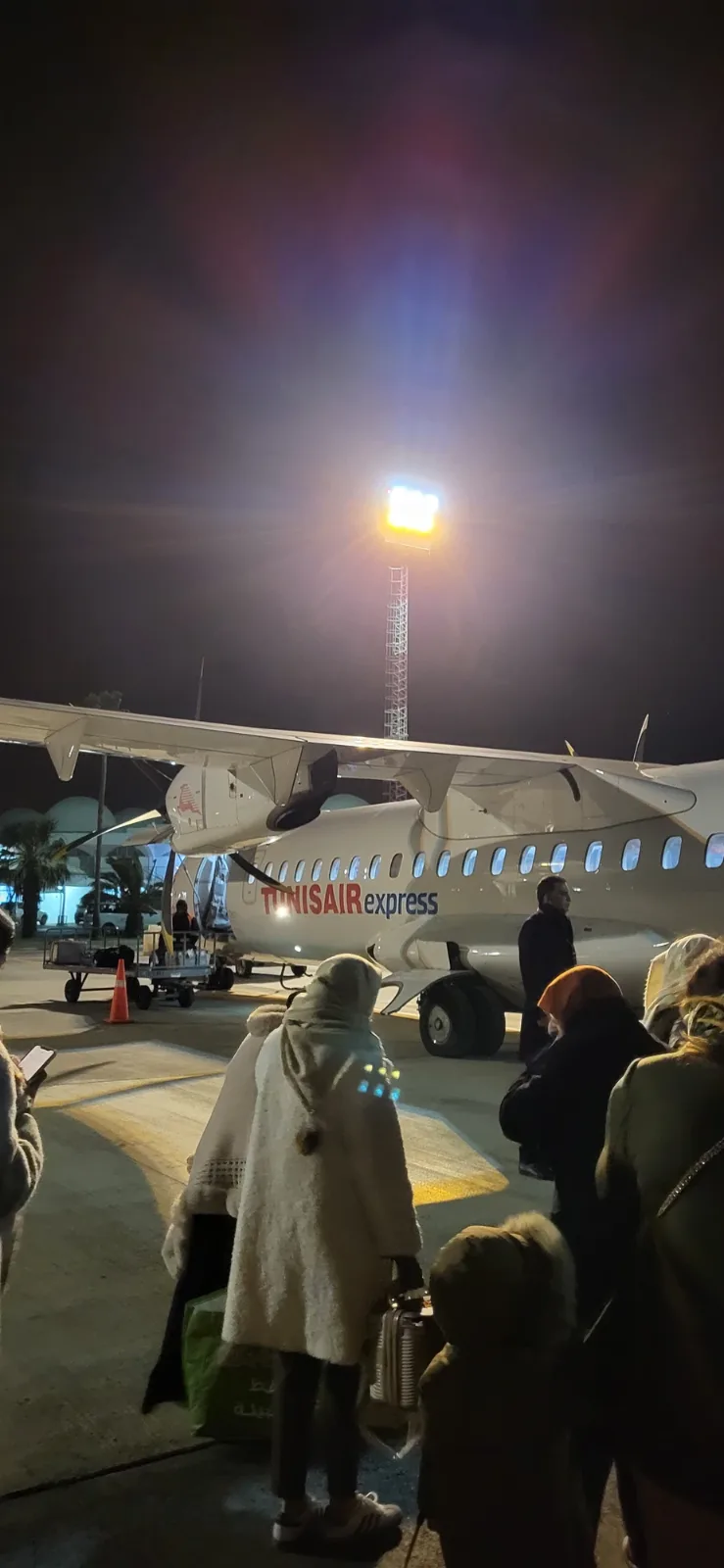
Normally, flying isn't much of a problem for me. But this time, we were travelling on a smaller propeller aircraft. Now, I know propeller aircraft aren't inherently less safe than regular jet aircraft, but personally? I'm not their biggest fan. Especially not when I'm already feeling sick.
So there we were, two completely miserable travellers at the airport, desperately wanting to get the journey over with. But apparently, Tunisia had one final surprise waiting for us.
Our flight was delayed by approximately six hours.
Six hours! Six hours of sitting around at the airport while feeling absolutely awful. At that point, I genuinely couldn't wait to get out of there. After an entire week of exploring, travelling, meeting people and discovering new places, this was definitely not how I'd imagined the trip ending.
Looking back, I can laugh about it. But at the time? Absolutely not. It was easily one of the worst travel days I'd experienced up to that point. Still, I guess every good travel adventure needs at least one disaster story. And this one definitely delivered. 😂
Would I Recommend Tunisia? Absolutely!
So, after everything we experienced, would I recommend visiting Tunisia?
Without a doubt.
Even though the trip ended with one of my worst travel days ever, Tunisia remains one of the most memorable countries I've visited. Not because everything went perfectly, not because we stayed in expensive hotels and definitely not because of that final flight. But because of everything we experienced along the way.
The ancient Roman ruins of Carthage and El Jem, the beautiful blue-and-white streets of Sidi Bou Saïd, the historic medinas of Tunis and Sousse, the endless olive groves and all the unexpected moments in between. And, of course, that unforgettable afternoon spent with a Tunisian family.
Before this trip, I knew very little about Tunisia. I mainly pictured beaches, deserts and camels. But after travelling through the country, I realised just how much there is to discover beyond the typical tourist destinations. And perhaps the biggest lesson?
You really don't need a huge budget to have an unforgettable adventure.
For around €700, including my flights, accommodation and expenses, I experienced a completely different culture, visited several cities and created memories I'll probably remember for the rest of my life. And the best part is that we organised everything ourselves. We booked our flights and accommodation separately using platforms like Booking.com, lastminute.com and Airbnb.
No organised round-trip package, no expensive private tour for the entire week. Just two friends exploring a country, figuring things out as we went and using local transportation whenever possible. Was it always easy? Definitely not. But that's exactly what made it so memorable.
Tunisia wasn't just my first trip to Africa. It was one of those journeys that made me realise how much of the world I still wanted to discover.
And looking back now, I'm so glad we decided to go. Until the next adventure! 🌍
— Dainyel
DainyelOnTheMove